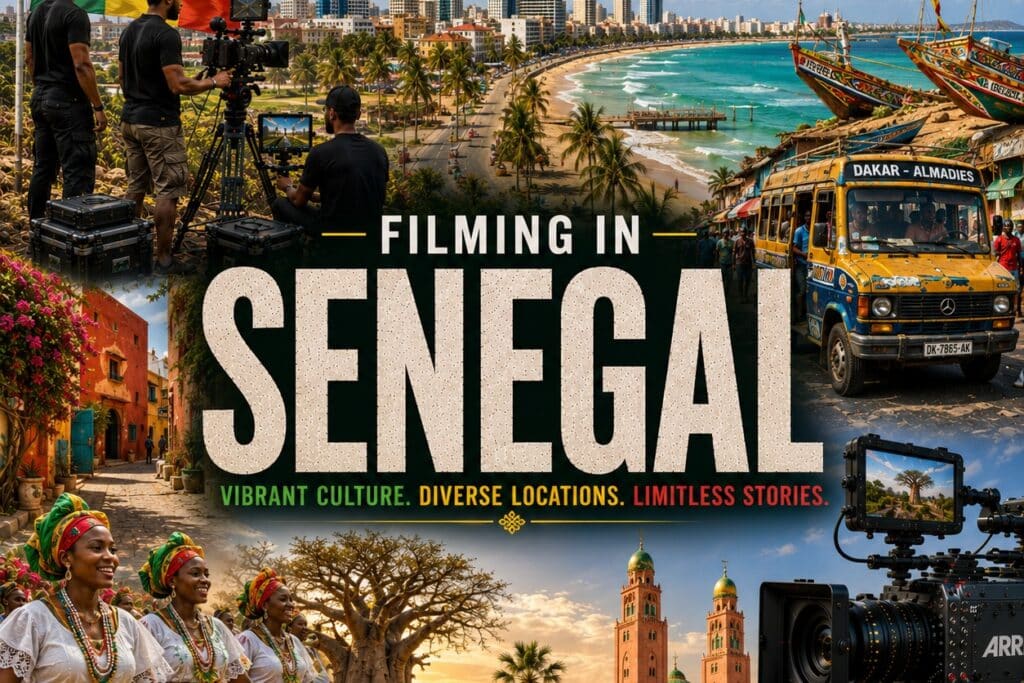
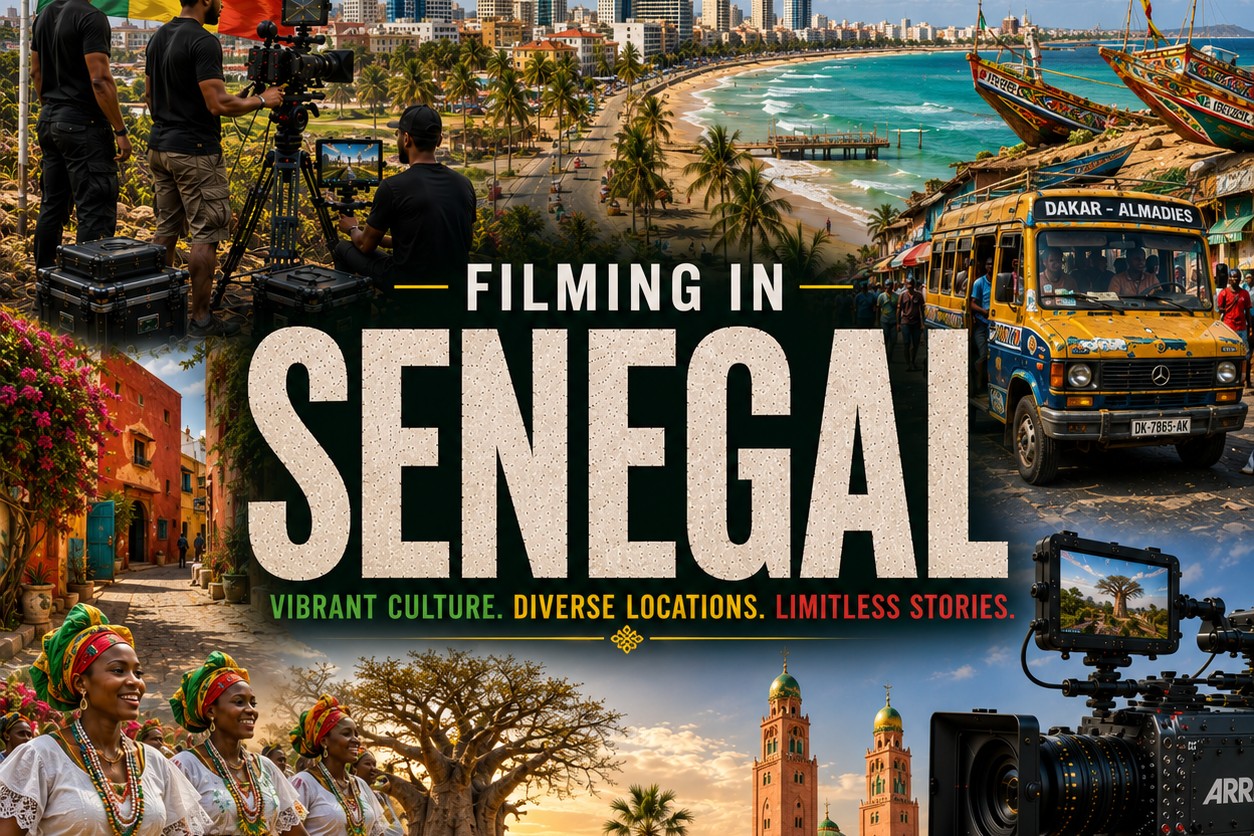
Filming in Senegal gives international productions one of West Africa’s most stable, welcoming and cinematic bases. From the energy of Dakar and the colonial streets of Saint-Louis to the pink waters of Lac Rose, the mangroves of the Sine-Saloum Delta and the heritage of Île de Gorée, filming in Senegal pairs extraordinary locations with a genuine film culture — this is the country of Ousmane Sembène, the “father of African cinema,” and of Mati Diop’s Cannes-winning Atlantique. This guide covers locations, permits, crew, equipment, customs, logistics, security and incentives, based on how productions actually work on the ground.

Quick answer: what to know about filming in Senegal
Filming in Senegal means access to vibrant cities, Atlantic coastline, UNESCO heritage sites and diverse landscapes, in one of the safest, most politically stable countries in West Africa. Senegal does not currently offer a national cash rebate, so the case for filming in Senegal rests on location variety, deep cultural heritage, a real local crew base and easy equipment import — Senegal is an ATA Carnet country. A local fixer is essential for permits, drone approvals and community access.
Top filming locations in Senegal
Senegal packs remarkable variety into a compact, accessible country. Dakar, on the Cap-Vert peninsula, delivers a dynamic capital: the Corniche, the Almadies (the westernmost point of mainland Africa), colourful markets, street life and the bright “car rapide” buses. Just offshore, Île de Gorée — a UNESCO World Heritage Site — offers pastel colonial architecture and the sobering House of Slaves. Lac Rose (Lake Retba) glows pink beside the dunes and the ocean; Saint-Louis, another UNESCO site, brings faded French-colonial grandeur and pirogue-filled waterways. For nature, the Sine-Saloum Delta (UNESCO) is a maze of mangroves and lagoons, the Djoudj National Bird Sanctuary (UNESCO) hosts flamingos and pelicans, and the Bandia Reserve adds accessible wildlife. Further south, lush Casamance, the Great Mosque of Touba and countless baobab-dotted plains round out the palette.
Filming permits in Senegal
Professional productions need filming authorisation, generally coordinated through the Ministry of Culture and the relevant local authorities, with additional permissions for heritage sites, protected areas and sensitive locations. In practice, much of the on-the-ground access — streets, markets, communities and private locations — is arranged by a local fixer who works directly with government contacts and community leaders. Lead times are reasonable by regional standards, but you should still allow a few weeks and confirm current requirements with your fixer before you travel.
Drone regulations for filming in Senegal
Drone operations are overseen by the civil aviation authority, ANACIM, and the process is strict and slow. Productions typically need an import permit and flight authorisation from ANACIM, plus a separate agreement from the Ministry of the Interior, ideally secured before arrival. Approvals can take several weeks to months, and under tightened 2026 security rules many applications are declined, so drone work must be planned well in advance with a local fixer handling the paperwork. If aerials are essential, build generous lead time into the schedule.
Customs, ATA Carnet and equipment import
Good news for producers: Senegal is an ATA Carnet country, so professional equipment can be temporarily imported on a carnet, avoiding import duties as long as the gear leaves with you. This makes bringing in cameras, lenses, lighting and grip considerably smoother than in many neighbouring markets. A local agent or fixer still coordinates clearance at Blaise Diagne International Airport to keep things moving, but the carnet system removes much of the friction and cost of temporary import.
Crew and Senegal’s film heritage
Senegal has one of the richest film cultures on the continent. As the home of Ousmane Sembène and, more recently, of internationally acclaimed filmmakers like Mati Diop, Dakar sustains an experienced local crew base: producers, fixers, directors of photography, camera assistants, gaffers, grips, sound, art department, hair and make-up and drivers. Crews work in French and Wolof, with English-speaking fixers coordinating international teams. For larger productions, specialist heads of department are sometimes brought in from France, Morocco or South Africa to supplement the local team.
Equipment
Dakar has a reasonable pool of professional camera, lighting and grip for commercials and documentaries, and the ATA Carnet system makes it straightforward to supplement local stock with cameras such as ARRI or RED, cine lenses and specialist gear flown in from Europe or regional hubs. As always, confirm exactly what is available locally with your fixer before deciding what to ship, and carry critical spares for remote locations.
Studios, post-production and logistics
Studio and post-production capacity is growing in Dakar but remains modest, so finishing — editing, grading, sound and VFX — is often completed abroad or split with a partner facility. Logistically, Senegal is relatively easy to work in: Blaise Diagne International Airport connects Dakar to Europe and the region, road networks to the main locations are decent, and distances are manageable. Reaching the delta, Casamance or the far north still calls for realistic scheduling and, in places, 4×4 transfers, all of which a local fixer builds into the plan.
Accommodation, transport and safety
Dakar and the main tourist areas offer international-standard hotels and serviced apartments, with lodges and guesthouses near the delta, Saint-Louis and Casamance. On the ground, production vehicles and experienced drivers handle city traffic and longer transfers. Senegal is widely regarded as one of the most stable and safe countries in West Africa for production; the main considerations are standard urban precautions, sensible scheduling, and awareness of the historically sensitive Casamance region, all of which an experienced local fixer manages as part of the plan.
Tax incentives and rebates for filming in Senegal
At the time of writing, Senegal does not offer a widely available national cash rebate or tax incentive for foreign commercials and feature films. The advantages of filming in Senegal come instead from its political stability, deep film heritage, ATA Carnet equipment import, genuine location diversity and competitive on-the-ground costs. For many productions, Senegal earns its place on the schedule because it is safe, welcoming and easy to work in, with imagery — from Gorée to Lac Rose to the delta — that stands apart.
Why choose African Fixer in Senegal
African Fixer provides end-to-end production support for filming in Senegal: permits and heritage-site approvals, drone authorisations, fixers and line producers, location scouting, carnet and customs clearance, crew, transport, accommodation, security planning and full production management. With experienced local teams and a network across the continent — including our guides to filming in Nigeria and filming in Madagascar — we make filming in Senegal smooth from prep to wrap.
Filming in Senegal: frequently asked questions
Do I need a permit for filming in Senegal?
Yes. Professional productions need filming authorisation, with extra permissions for heritage sites, protected areas and sensitive locations. A local fixer arranges most on-the-ground access with government and community contacts.
How long do permits take?
Allow a few weeks for filming permits; drone approvals take considerably longer. Start early and work through a local fixer to secure heritage-site and community access.
Can I fly a drone in Senegal?
Only with approval from ANACIM plus a Ministry of the Interior agreement, ideally secured before arrival. Approvals can take weeks to months and are often declined, so plan drone work well ahead.
Does Senegal accept an ATA Carnet?
Yes. Senegal is an ATA Carnet country, so professional equipment can be temporarily imported on a carnet without paying import duties, making gear import much smoother than in many neighbouring countries.
Is professional equipment available locally?
Dakar has a reasonable pool of camera, lighting and grip. Higher-end packages are easily supplemented with kit brought in on a carnet from Europe or regional hubs.
What languages do crews work in?
Crews work in French and Wolof, with English-speaking fixers coordinating international teams, so communication is straightforward with the right local partner.
Is there a cash rebate for filming in Senegal?
No. There is currently no national cash rebate or tax incentive for foreign productions. The draw is stability, heritage, ATA Carnet import, location diversity and competitive costs.
What are the best locations for filming in Senegal?
Dakar and the Almadies, Île de Gorée, Lac Rose, Saint-Louis, the Sine-Saloum Delta and Djoudj bird sanctuary, plus Casamance and the Great Mosque of Touba.
Is Senegal safe for film production?
Yes. Senegal is one of the most stable and safe countries in West Africa for production. Standard urban precautions apply, and a fixer manages sensitivities such as the Casamance region.
How do I get around during a shoot?
Blaise Diagne International Airport connects Dakar to Europe and the region; road networks to the main locations are decent, with 4×4 transfers for remote areas like the delta and Casamance.
Can I hire a local crew?
Yes. Senegal’s strong film heritage means an experienced local crew base across departments, supplemented for larger jobs with specialists from France, Morocco or South Africa.
Who can organise a production in Senegal?
African Fixer handles permits, drones, carnet and customs, crew, equipment, transport, accommodation and security for filming in Senegal, end to end.
Plan your production in Senegal
Planning a production in Senegal? Contact African Fixer for local expertise and complete production support — from permits and carnet clearance to crew, equipment, logistics and security, we make filming in Senegal simple.