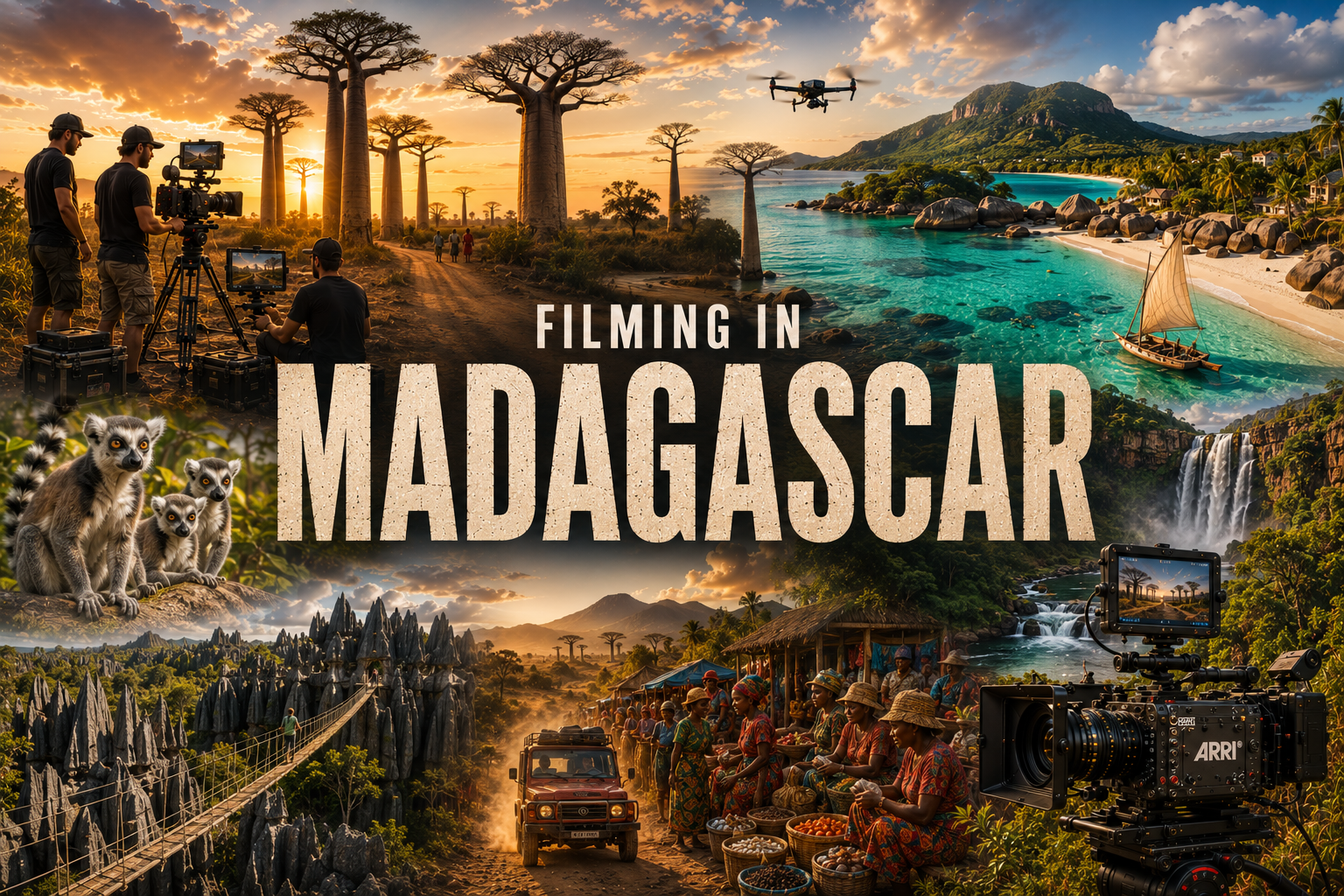
Filming in Madagascar offers international productions something almost nowhere else on earth can: an island of endemic wildlife, alien limestone forests, avenues of giant baobabs and turquoise island coastlines, all at competitive costs. For commercials, documentaries, television, branded content and features, filming in Madagascar rewards productions that plan carefully — the locations are extraordinary, but the logistics demand experienced local support. This guide covers the country’s best locations, permits, crew, equipment, customs, transport, security and incentives, based on how productions actually work on the ground.

Quick answer: what to know about filming in Madagascar
Filming in Madagascar is about access to unique, endemic locations — lemurs and rainforest, the Avenue of the Baobabs, the Tsingy limestone “stone forest”, and island beaches — at competitive costs. Madagascar does not run a national cash rebate, so the case for filming in Madagascar rests on one-of-a-kind scenery, biodiversity and local expertise rather than incentives. Because permits, drone approvals, customs and travel between remote locations are complex, a local fixer is essential.
Top filming locations in Madagascar
Madagascar’s locations are its headline attraction. The Avenue of the Baobabs near Morondava is the country’s most iconic image, especially at sunrise and sunset. The Tsingy de Bemaraha, a UNESCO World Heritage Site, is an otherworldly forest of razor-sharp limestone pinnacles crossed by rope bridges. For wildlife, Andasibe-Mantadia and Ranomafana national parks deliver rainforest and lemurs, while Isalo National Park offers dramatic sandstone canyons and natural pools. The coast and islands — Nosy Be, Île Sainte-Marie, Ifaty and Anakao — bring white-sand beaches, coral reefs and traditional pirogue sailboats. Inland, the capital Antananarivo and the highland town of Antsirabe add colonial architecture, rice terraces and vibrant markets.
Filming permits in Madagascar
Professional productions need filming authorisation, typically coordinated through the Ministry of Communication and Culture, with separate permissions for specific sites. Any shoot in the national parks and reserves — where much of the country’s most spectacular scenery and wildlife sits — requires approval from Madagascar National Parks (MNP), and protected areas, cultural sites and some communities have their own protocols. Lead times can be long and paperwork is document-heavy, so allow at least three to four weeks and work through a local fixer who can secure approvals and community access before you travel.
Drone regulations for filming in Madagascar
Drone rules are strict and slow. Commercial drone operations are overseen by the Aviation Civile de Madagascar (ACM), and approvals are notoriously bureaucratic — often requiring 30 to 60 days of lead time, Ministry of Defence sign-off, detailed flight schedules and proof of aviation insurance. If aerials of the baobabs, Tsingy or coastline are central to your shoot, start the drone permit process as early as possible and budget generous time; a local fixer is essential to navigate the approvals.
Customs, ATA Carnet and equipment import
Madagascar is not part of the ATA Carnet system, so temporary import of production equipment is handled through customs temporary-admission procedures rather than a carnet. In practice, most productions fly their kit in with the crew and clear it on arrival with the help of a local agent, who arranges the documentation and any duty guarantee. Because clearance is time-sensitive, confirm the current procedure and required paperwork with your fixer well before departure to avoid gear being held at the airport.
Crew and local expertise
Madagascar has a capable local crew base — producers, fixers, camera assistants, grips, sound, art department, HMU and drivers — used to supporting international shoots in demanding conditions. Crews are typically French- and Malagasy-speaking, with English-speaking fixers coordinating international teams. For larger productions, key heads of department and specialist technicians are often brought in from South Africa, Réunion or France to supplement the local team, something a good fixer will plan around.
Equipment
Antananarivo has basic camera, lighting and grip available for smaller shoots, but high-end packages are limited on the island. For features, commercials and larger documentaries, productions generally fly in cameras such as ARRI or RED, lenses, lighting and specialist gear from regional hubs — most often South Africa, Réunion or France — and clear it through customs on arrival. Confirm exactly what is available locally with your fixer before deciding what to ship, and always carry critical spares.
Studios, post-production and logistics
Studio and post-production capacity on the island is limited, so most editing, grading, sound and VFX is completed abroad. Logistics are the real challenge of filming in Madagascar: distances are long, roads outside the main routes can be rough and slow, and reaching remote locations such as the Tsingy or Morondava often means domestic flights (via Tsaradia) combined with 4×4 transfers. The rainy season, roughly November to March, can affect access, so schedule and route planning with an experienced fixer is critical.
Accommodation, transport and safety
Antananarivo, Nosy Be and the main tourist areas offer comfortable hotels and lodges, while remote shoots may rely on simpler lodges or serviced camps arranged in advance. Domestic flights connect the main hubs and are usually the fastest way to move a unit, with 4×4 vehicles for the final legs. Madagascar is generally calm for production with proper local support; the main considerations are petty crime in the capital, sensible scheduling around weather and roads, and clear communication — all of which a local fixer builds into the plan.
Tax incentives and rebates for filming in Madagascar
At the time of writing, Madagascar does not offer a widely available national cash rebate for international productions. The advantages of filming in Madagascar come instead from truly unique locations, world-famous biodiversity, competitive on-the-ground costs and experienced local expertise. For most productions, the island earns its place on the schedule because it delivers imagery — baobabs, lemurs, the Tsingy, island coastlines — that simply cannot be shot anywhere else, rather than because of an incentive.
Why choose African Fixer in Madagascar
African Fixer provides end-to-end production support for filming in Madagascar: permits and national-park approvals, drone authorisations, fixers and line producers, location scouting, customs and equipment clearance, crew, transport, accommodation, security planning and full production management. With experienced local teams and a network across the continent — including our guides to filming in Kenya and filming in Nigeria — we turn Madagascar’s remote, spectacular locations into a shoot that runs smoothly.
Filming in Madagascar: frequently asked questions
Do I need a permit for filming in Madagascar?
Yes. Professional productions need filming authorisation, and any shoot in national parks, reserves or cultural sites needs approval from Madagascar National Parks and the relevant authorities. Work through a local fixer.
How long do permits take?
Allow at least three to four weeks for filming permits, and longer for drones. Remote and protected locations require extra lead time for approvals and community access.
Can I fly a drone in Madagascar?
Yes, with approval from the Aviation Civile de Madagascar, but the process is slow — often 30 to 60 days and requiring Ministry of Defence sign-off, flight schedules and insurance. Start early.
Does Madagascar accept an ATA Carnet?
No. Madagascar is not in the ATA Carnet system. Equipment is usually flown in with the crew and cleared through customs temporary-admission procedures with a local agent’s help.
Is professional equipment available locally?
Basic camera, lighting and grip are available in Antananarivo, but high-end packages are limited. Most larger shoots fly gear in from South Africa, Réunion or France.
What languages do crews work in?
Crews work in French and Malagasy, with English-speaking fixers coordinating international teams, so communication is straightforward with the right local partner.
Is there a cash rebate for filming in Madagascar?
No. There is no widely available national cash rebate. The draw is unique locations, biodiversity and competitive costs rather than an incentive scheme.
What are the best locations for filming in Madagascar?
The Avenue of the Baobabs, the Tsingy de Bemaraha stone forest, Andasibe and Ranomafana for lemurs and rainforest, Isalo’s canyons, and the islands of Nosy Be and Sainte-Marie.
How do I travel between locations?
Domestic flights connect the main hubs and are usually fastest, with 4×4 vehicles for the final legs to remote sites. Plan around long transfers and the November–March rains.
Is Madagascar safe for film production?
Generally yes, with proper local support. The main considerations are petty crime in the capital and the logistical challenges of remote travel, all managed by an experienced fixer.
Can I hire a local crew?
Yes. Madagascar has a capable local crew base, often supplemented with specialists from South Africa, Réunion or France for larger productions.
Who can organise a production in Madagascar?
African Fixer handles permits, park approvals, drones, customs, crew, equipment, transport, accommodation and security for filming in Madagascar, end to end.
Plan your production in Madagascar
Planning a production in Madagascar? Contact African Fixer for local expertise and complete production support — from permits and park access to crew, equipment, logistics and security, we make filming in Madagascar simple.