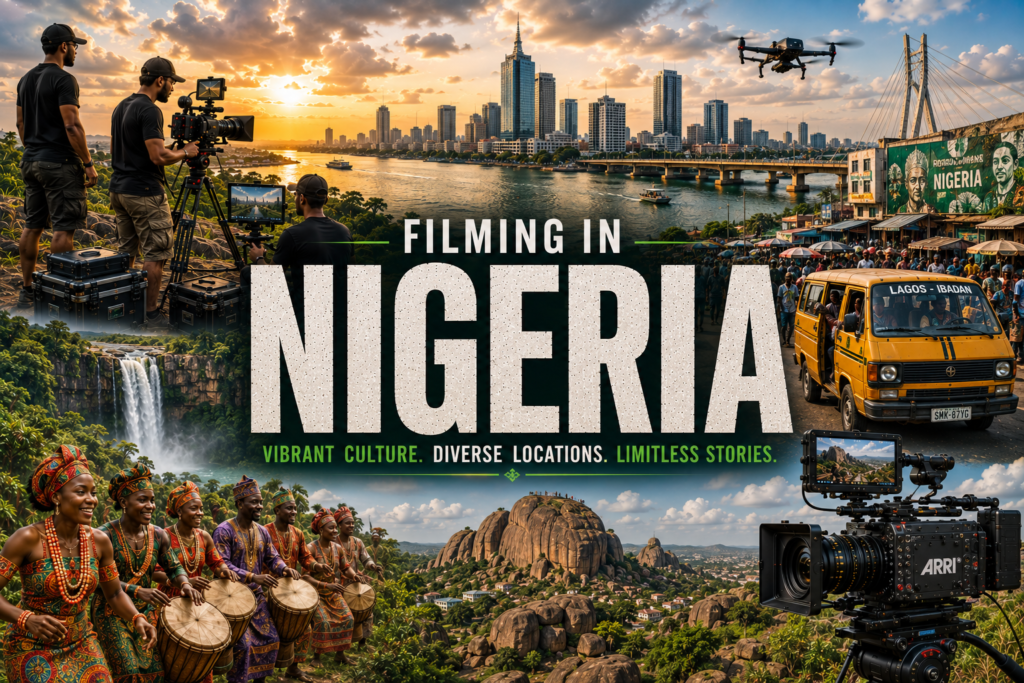
Filming in Nigeria puts productions at the centre of one of the largest film industries on earth. Home to Nollywood, which turns out roughly 2,500 films a year, Nigeria offers a deep, English-speaking crew base, extraordinary location variety and highly competitive costs. For international producers weighing commercials, documentaries, branded content, television and features, filming in Nigeria increasingly makes creative and commercial sense in 2026 — especially as the country moves to formalise production incentives and co-production treaties. This guide covers locations, permits, crew, equipment, logistics, security and incentives, based on how productions actually work on the ground.

Quick answer: what to know about filming in Nigeria
Filming in Nigeria is about access to a vast, experienced Nollywood crew base, diverse locations from the Lagos megacity to mountains, waterfalls and savannah, and costs that stretch a budget further than most rival destinations. Nigeria does not yet run a national cash rebate, so the case for filming in Nigeria rests on local expertise, scale of talent and location variety — though a formal production incentive scheme and co-production treaties with Brazil and India have been announced for 2026. A local fixer is essential for permits, customs and logistics.
Top filming locations in Nigeria
Nigeria’s scale means genuine location diversity. Lagos is the commercial and creative heart: the skyline and waterfront of Victoria Island and Lekki, the energy of markets and motor parks, the iconic yellow danfo buses, Makoko’s stilt community and the sweep of the Third Mainland Bridge. Abuja offers modern architecture, wide boulevards and the dramatic monolith of Zuma Rock nearby. Beyond the cities, Calabar and Cross River bring rainforest, colonial-era streets and the Obudu Mountain Resort’s highland plateau; Olumo Rock in Abeokuta and the Idanre Hills deliver striking granite formations; Yankari National Park provides savannah and wildlife; the Osun-Osogbo Sacred Grove (a UNESCO World Heritage Site) and the ancient city of Kano add deep cultural texture; and Erin-Ijesha (Olumirin) waterfalls offer lush, cinematic natural settings.
Filming permits in Nigeria
A filming permit is required for professional productions. In Lagos, permits are handled by the Lagos State Film and Video Censors Board, while productions elsewhere generally work through the Nigerian Film Corporation and the National Film and Video Censors Board (NFVCB). Applications typically require a synopsis, a detailed shooting schedule, a full equipment list, crew details and specific location information. Individual locations — federal sites, airports, ports, bridges and protected areas — often need their own separate approvals. Build in at least two to three weeks of lead time, and always confirm current requirements through a local fixer before you travel, as processes and fees can change.
Drone regulations for filming in Nigeria
Drone operations are regulated by the Nigeria Civil Aviation Authority (NCAA), and the rules are strict. International drone pilots cannot fly on their own credentials — only licensed local operators can obtain the necessary permits. A flight plan must be submitted to and authorised by the NCAA for each individual flight, and processing can take up to four weeks. If aerials are central to your shoot, engage a licensed Nigerian drone operator early and allow generous lead time for approvals.
Customs, ATA Carnet and equipment import
Nigeria is not part of the ATA Carnet system, so temporary import of production equipment is handled through a Temporary Importation Permit (TIP) issued by the Nigeria Customs Service. Expect a minimum of around ten working days to process, and be prepared for a bond or guarantee to be required against the value of the gear. Because customs clearance is document-heavy and time-sensitive, a local agent or fixer is essential to pre-clear kit, avoid demurrage and keep a shoot on schedule.
Crew: the Nollywood advantage
Nigeria’s biggest single asset is its people. Nollywood is one of the most prolific film industries in the world, which means a deep, experienced and English-speaking crew base: producers, line producers, fixers, directors of photography, camera assistants, gaffers, grips, sound recordists, art department, hair and make-up, stylists and licensed drone operators. Crews are used to fast turnarounds and resourceful problem-solving, and the shared working language removes the friction international productions often hit elsewhere on the continent.
Equipment and rental houses
Lagos anchors Nigeria’s equipment market, with rental houses carrying professional camera systems including ARRI, RED and Sony Venice, along with cine lenses, lighting, grip and stabilisation. For very specialised kit — certain large-format packages, technocranes or specialist optics — productions sometimes supplement locally available gear with equipment brought in from regional hubs such as Johannesburg or London under a Temporary Importation Permit. A good local fixer will confirm exactly what is available in-country before you decide what to ship.
Studios and post-production
Nigeria’s studio and post-production capacity has grown quickly alongside Nollywood and the streaming boom. Lagos hosts established players and purpose-built facilities offering sound stages, editing, colour grading, sound design and a growing VFX capability. For projects that need finishing to international delivery specs, work can be completed in-country or split with a partner facility abroad — your production plan should confirm the pipeline early.
Accommodation, transport and logistics
Major cities offer international-standard hotels and serviced apartments, and domestic flights connect Lagos, Abuja, Port Harcourt, Calabar, Kano and other hubs, which is often the fastest way to move a unit between regions. On the ground, expect to plan around traffic in Lagos in particular; experienced production drivers, reliable vehicles and realistic call times are essential. A local fixer coordinates transport, accommodation, catering and the day-to-day logistics that keep a shoot moving.
Safety and security
Security planning is part of any professional shoot in Nigeria, and it should be approached with balance rather than alarm. The main production hubs — Lagos, Abuja and Calabar — are worked routinely by local and international crews with the right support in place. Some regions, particularly parts of the north-east, are not suitable for production, and locations should be selected and risk-assessed with experienced local advisers. Good practice includes location-specific risk assessments, trusted local security, clear communications and sensible scheduling — all of which a local fixer builds into the plan.
Tax incentives and rebates for filming in Nigeria
At the time of writing, Nigeria does not offer a widely available national cash rebate for international productions. The advantages of filming in Nigeria instead come from competitive costs, the scale of local expertise and the sheer variety of locations. That picture is changing: the government has announced a production incentive scheme for 2026 under the broader “Screen Nigeria” blueprint, along with co-production treaties expected with Brazil and India. These developments are promising, but until they are formally legislated, producers should not build finance plans around them — treat any incentive as a bonus to confirm, not a line to bank on. A local partner will keep you updated as the schemes take shape.
Why choose African Fixer in Nigeria
African Fixer provides end-to-end production support for filming in Nigeria: permits and approvals, fixers and line producers, location scouting, customs and equipment clearance, security planning, transport, accommodation, crew and equipment sourcing, and full production management. With experienced local teams and a network across the continent — including our guides to filming in Ghana and filming in Kenya, we help international productions land, shoot and wrap smoothly — turning Nigeria’s scale and diversity into a genuine advantage rather than a logistical headache.
Filming in Nigeria: frequently asked questions
Do I need a permit for filming in Nigeria?
Yes. Professional productions need a filming permit — issued by the Lagos State Film and Video Censors Board in Lagos, or via the Nigerian Film Corporation and NFVCB elsewhere — plus separate approvals for specific or protected locations.
How long do permits take?
Allow at least two to three weeks. Complex locations, federal sites and drone approvals can take longer, so start early and work through a local fixer.
Can I fly a drone in Nigeria?
Only with a licensed local operator. The NCAA does not permit international pilots to fly on their own credentials, and each flight needs an approved flight plan — allow up to four weeks.
Does Nigeria accept an ATA Carnet?
No. Nigeria is not in the ATA Carnet system. Temporary equipment import uses a Temporary Importation Permit through the Nigeria Customs Service, often with a bond, so budget around ten working days minimum.
Is professional camera equipment available locally?
Yes. Lagos rental houses carry ARRI, RED and Sony Venice packages plus lenses, lighting and grip. Very specialised kit is sometimes imported to supplement local stock.
What language do crews work in?
English is Nigeria’s official language and the working language on set, which makes filming in Nigeria straightforward for international teams.
Is there a cash rebate for filming in Nigeria?
Not yet. There is no widely available national cash rebate. A 2026 production incentive scheme and co-production treaties have been announced but are not yet legislated, so do not build a finance plan around them.
Is Nigeria safe for film production?
The main hubs of Lagos, Abuja and Calabar are worked regularly by productions with proper local support and security planning. Some regions are unsuitable and should be avoided; a local fixer risk-assesses every location.
What are the best locations for filming in Nigeria?
Lagos and Abuja for urban energy, Calabar and Obudu for rainforest and highlands, Zuma Rock, Olumo Rock and Idanre Hills for landscapes, Yankari for savannah, and Osun-Osogbo and Kano for heritage.
How do I get around during a shoot?
Domestic flights link the main cities and are often the quickest way to move a unit; on the ground, plan around Lagos traffic with experienced production drivers and realistic call times.
Can I hire a full local crew?
Yes. Nollywood provides a deep, experienced crew base across every department, from DOPs and gaffers to art, HMU and drone operators — a major reason filming in Nigeria is so cost-effective.
Who can help organise a production in Nigeria?
African Fixer handles permits, customs, crew, equipment, transport, accommodation, security and full production management for filming in Nigeria, end to end.
Plan your production in Nigeria
Planning a production in Nigeria? Contact African Fixer for local expertise and complete production support — from permits and crew to equipment, logistics and security, we make filming in Nigeria simple.